
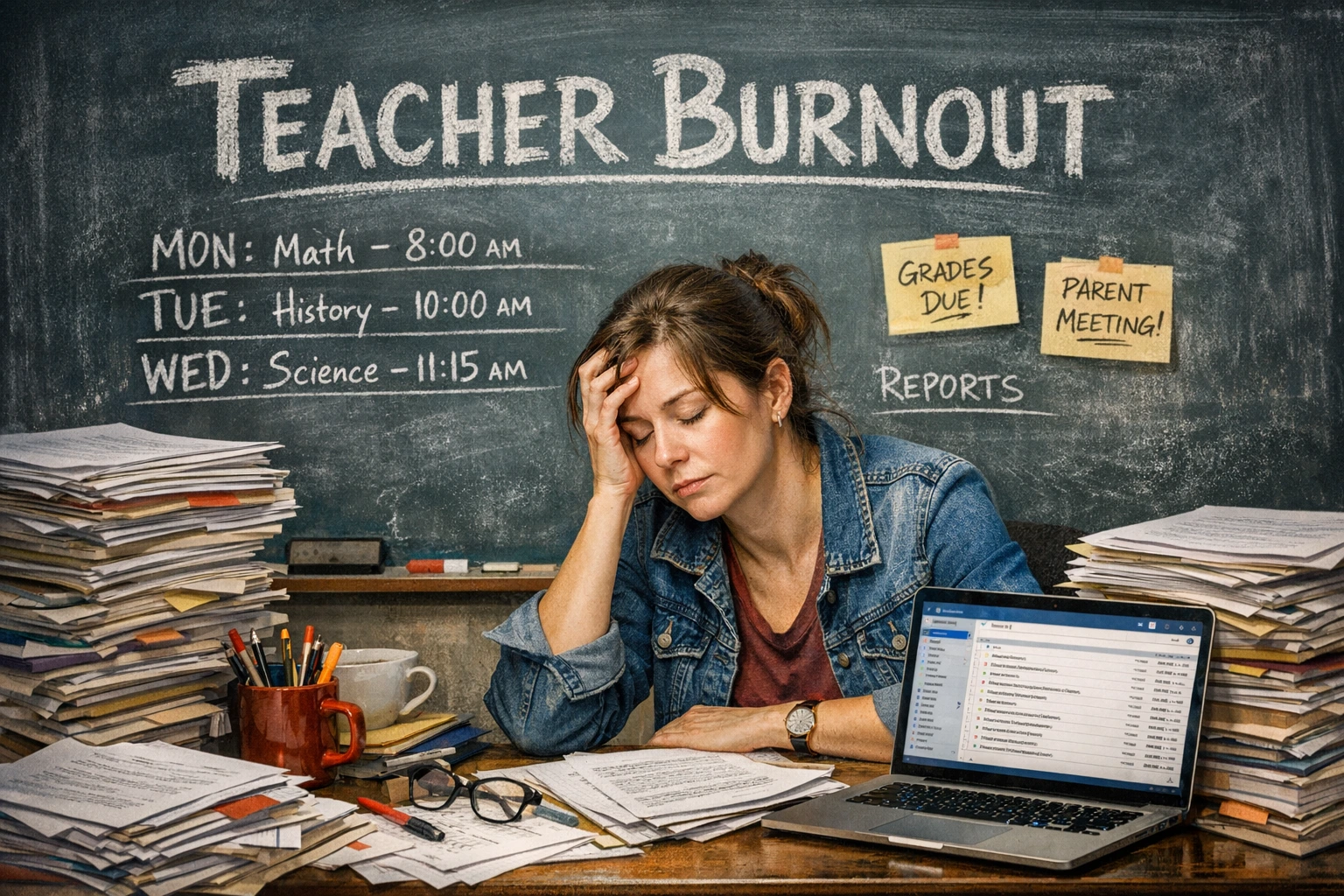
Why K-12 Teachers Are Burning Out — And What the Research Says About Fixing It
It starts with Sunday evenings.
The feeling of dread that creeps in before the week begins. The stack of ungraded assignments on the kitchen table. The parent emails left unanswered since Thursday. The attendance spreadsheet that somehow never quite captures everything that happened in second period.
For millions of American K-12 teachers, this isn't an occasional rough week. It's the baseline.
In 2024, 84% of U.S. public school teachers reported they don't have enough time during their regular work hours to do everything expected of them - grading, lesson planning, paperwork, and answering emails. That's not a rounding error. That's a near-universal experience shared across grades, subjects, and school districts.
This article doesn't offer five quick tips or a productivity hack. Instead, it takes a hard look at what the data actually says about teacher burnout in K-12 schools: what's causing it, what it costs, and - critically - what the research says genuinely works to address it.
The Scale of the Problem: What the Numbers Actually Say
Teacher burnout isn't new, but its current scale is striking.
According to a 2024 RAND survey of nearly 1,500 public K-12 teachers, 60% of educators reported feelings of burnout — saying the stress and disappointments of teaching are not worth it. A Gallup study found that K-12 teachers have the highest burnout rate of any occupation surveyed, with 52% reporting burnout. That's higher than nurses, social workers, and emergency responders.
The human cost is severe. In the same 2024 RAND survey:
- 59% of teachers reported frequent job-related stress
- 19% showed chronic symptoms of depression
- Teachers worked an average of 9 hours more per week than comparable working adults — nearly two extra hours every single day — while earning roughly $18,000 less in base pay
And the pipeline is draining. An estimated 575,000 public school teachers may leave the profession entirely by 2028, with another 600,000 expected to change schools. For a system already stretched thin, this isn't a manageable attrition rate. It's a structural crisis.
The Real Culprit: It's Not Teaching
Here's something the data makes very clear: teachers are not burning out because of teaching.
Research consistently shows that educators remain deeply satisfied with the act of instruction — connecting with students, watching them grow, and facilitating those "lightbulb moments." What drains them is everything else.
A systematic research synthesis published in the journal Educational Review found that teacher workload had increased primarily because of the intrusion of "non-core" tasks into the expected work of educators. Teachers were largely satisfied with their teaching workload but profoundly dissatisfied with their non-teaching workload. That distinction matters enormously for how we think about solutions.
So what specifically is eating teachers' time?
Grading and feedback: EdWeek research puts grading time at 5–10 hours per week for the average teacher. For subjects requiring detailed written feedback — English, history, project-based STEM — this can run even higher.
Administrative paperwork: Taking attendance, logging behavior incidents, completing compliance forms, managing student records. The OECD's 2024 TALIS report found that roughly half of teachers globally identify excessive administrative work as their primary source of work-related stress — the single largest stressor measured.
Parent communication: Writing individual parent emails takes time most teachers simply don't have. A 2022 McKinsey report estimated that 20–40% of the tasks teachers spend time on — including communication, lesson planning, and administration — could realistically be handled by technology.
Lesson planning: High school teachers average just five hours of planning time per week. Middle school teachers often get three to five hours. Elementary teachers frequently get even less — sometimes under an hour per day.
The painful irony is that the tasks stealing the most time are the ones with the least direct impact on student learning. Teachers become educators to teach. They're burning out because they spend so much of their working lives doing something else.
How Burnout Ripples Outward
Teacher burnout isn't only a problem for teachers. It degrades the entire learning environment.
When educators are chronically exhausted, their capacity to bring creativity, warmth, and presence to their classrooms diminishes. Research shows burned-out teachers are more likely to default to rigid routines, less likely to attempt innovative lessons, and more prone to emotional withdrawal from students — what psychologists call "depersonalization."
Student outcomes follow. Schools with high teacher turnover show measurable setbacks in academic performance, particularly for younger students. Elementary and middle school students in grades three through eight experienced some of the steepest pandemic learning losses — and those losses are hardest to recover in environments where the adult relationships in the room are unstable.
There's also a direct connection to student behavior. Teachers who lack confidence in classroom management — often those who are overwhelmed and under-supported — inadvertently create conditions where classroom disruption increases. In 2024, 56% of teachers reported classroom disruptions as an increasing problem. Burnout and behavior issues form a compounding cycle.
Parents feel it too. A teacher who is running on empty has fewer reserves for the thoughtful communication that keeps families informed and engaged. The 2024 Harvard education research noted that parent-teacher meetings about struggling students are among the most impactful interventions available — and the least likely to happen when teachers are buried in paperwork.
What the Research Says Actually Works
This is where the conversation usually goes off the rails. Most "solutions" to teacher burnout place the responsibility squarely on individual educators: practice self-care, set better boundaries, meditate. These suggestions aren't harmful, but they miss the point entirely.
Research is unambiguous: burnout is a systemic problem that requires systemic solutions. Interventions that focus on individual coping have consistently weaker effects than structural changes to how schools operate.
Here's what the evidence actually supports:
1. Reduce administrative paperwork at the school level
Schools that systematically minimize administrative paperwork see measurable reductions in burnout. This means auditing what teachers are actually required to document and eliminating redundant or low-value reporting. It means building systems that capture behavioral data and attendance as part of normal classroom flow — not as an additional task on top of instruction.
Schoolwide systems with clear expectations for students and families can directly relieve pressure on individual teachers.
2. Give teachers back time — specifically, the right kind of time
The data shows elementary teachers often have under an hour of planning time daily. But more time alone isn't the solution if it's immediately consumed by administrative catch-up. The quality and structure of that time matters as much as the quantity.
When teachers have protected time that isn't swallowed by paperwork, they use it for the work that actually improves their effectiveness: collaborating with colleagues, refining lessons, and preparing more thoughtful parent communications.
3. Deploy technology strategically — especially AI
This is where the research is genuinely exciting. A 2024 Walton Family Foundation and Gallup poll of over 2,200 teachers found that educators who use AI tools on a weekly basis save an average of 5.9 hours per week — equivalent to roughly six weeks per school year. If that time were reclaimed across the profession, the modeling suggests it could meaningfully reduce turnover and improve student outcomes.
Teachers in the survey reported using AI tools to draft parent emails, create differentiated materials, develop assessments, and generate progress notes. Critically, 64% reported that the materials they modified with AI assistance were higher quality than what they would have produced under time pressure alone.
The key word is "modified." The most effective use of AI in teaching isn't replacement — it's draft generation. A teacher who spends 45 minutes writing a parent email explaining a student's struggling behavior pattern could, instead, spend 5 minutes reviewing and personalizing a well-structured draft generated from the actual classroom data. The teacher's expertise and relationship with the family remains central. The grinding labor of staring at a blank page does not.
4. Make parent communication easier, not just more frequent
One counterintuitive finding: when parents have access to real-time information about their child's grades, attendance, and behavior, the volume of anxious "how are we doing?" emails to teachers actually drops.
Transparency replaces uncertainty. Instead of parents reaching out because they haven't heard anything for weeks, they're reading information as it updates — and reaching out with specific, actionable questions or to share useful context. For teachers, this shift can meaningfully reduce the reactive communication load that consumes so much unplanned time.
A Note on What Doesn't Work
Because it's worth saying directly: the following interventions have weak evidence for reducing teacher burnout at scale.
"Remember your why" messaging — Asking burned-out teachers to reconnect with their passion may feel supportive but doesn't address the structural conditions causing exhaustion.
Individual self-care mandates — Yoga in the break room is fine. It doesn't fix a 60-hour workweek.
Adding more professional development — New training sessions consume the limited non-teaching time teachers already have. Unless PD directly reduces workload burden, it often adds to it.
Pay raises alone — Compensation matters and teachers are underpaid. But the 2024 RAND data shows that teachers earning adequate pay still burn out at high rates when working conditions aren't addressed. Money and time aren't interchangeable.
The Window That's Opening
There's an argument that this moment — despite the difficult statistics — is actually the most promising in decades for genuinely improving teacher working conditions.
AI tools capable of handling genuine administrative work have arrived. The research base on what works to reduce burnout has grown substantially. And the visibility of the teacher shortage has pushed the conversation from the faculty lounge to policy tables.
Gallup's research found that teachers are 62% less likely to leave their school when they feel engaged and supported. That's an enormous lever. The schools getting this right aren't just retaining their best teachers — they're demonstrating that sustainable teaching is actually achievable.
The question isn't whether the problem is real. The numbers are clear. The question is whether schools, administrators, and the tools teachers use every day can evolve fast enough to meet it.
What This Means for Your Classroom
If you're a teacher reading this, the research offers a practical takeaway that's easy to miss in the aggregate data: the single highest-leverage change you can make is reducing the time you spend on tasks that don't require your expertise.
Taking attendance doesn't require a master's degree. Generating a first draft of a parent email doesn't require fifteen years of classroom experience. Calculating a student's grade average certainly doesn't.
Your expertise — your knowledge of each student, your instructional judgment, your relationship with families — is irreplaceable. The administrative burden attached to that expertise largely isn't.
Tools that centralize grades, attendance, and behavior data in one place; that let parents check in without requiring a teacher-written update every time; that use AI to draft communications from classroom data rather than from memory - these aren't luxuries. Given what the research shows about time and burnout, they're among the most direct interventions available to individual teachers right now.
The Sunday evening feeling doesn't have to be the baseline.
Frequently Asked Questions About Teacher Burnout
1. What are the main causes of teacher burnout?
Research consistently points to non-teaching workload as the primary driver. Grading, administrative paperwork, attendance tracking, behavior documentation, and parent communication consume an estimated 5–15 hours per week beyond instruction time. The 2024 OECD TALIS report identified excessive administrative work as the single largest source of work-related stress among teachers globally — above class sizes, student behavior, or pay. Teachers largely enter the profession to teach; burnout accelerates when most of their working hours are spent on everything but that.
2. How many hours a week do K-12 teachers actually work?
More than most people assume. The 2024 RAND study of nearly 1,500 public school teachers found they work an average of 9 hours more per week than comparable working adults — roughly 54–56 hours total. That includes evenings and weekends spent grading, planning, and communicating with families. Despite these hours, the base salary for teachers runs approximately $18,000 below comparable college-educated workers in other fields.
3. Is teacher burnout getting worse or better?
The data suggests it has worsened since 2020 and has not fully recovered. Pre-pandemic surveys showed burnout rates around 40–45% among K-12 teachers. By 2024, Gallup found 52% of teachers reporting burnout — the highest rate of any profession in their survey. RAND's 2024 data put the figure at 60% when measuring feelings of chronic job stress. The combination of pandemic learning loss recovery, increased behavioral challenges in classrooms, and persistent staffing shortages has kept pressure elevated.
4. What is the difference between teacher stress and teacher burnout?
Stress is acute — it spikes under pressure and recovers with rest. Burnout is chronic — it builds over months or years and doesn't resolve with a weekend off. Psychologists typically define burnout through three dimensions: emotional exhaustion (feeling depleted), depersonalization (emotional detachment from students and colleagues), and reduced sense of personal accomplishment. A stressed teacher still cares deeply about the job. A burned-out teacher may find it increasingly hard to access that care at all. The distinction matters because the interventions are different — burnout requires structural change, not just recovery time.
5. How does teacher burnout affect students?
The effects are measurable and significant. Research shows burned-out teachers are more likely to default to rigid routines, less likely to attempt differentiated or creative instruction, and more prone to emotional withdrawal from student relationships. Student achievement suffers most in schools with high teacher turnover — studies tracking elementary and middle school students show setbacks in reading and math performance that are directly correlated with instability in teaching staff. Classroom behavior also tends to worsen, creating a compounding cycle: overwhelmed teachers are less equipped to manage disruption, which increases disruption, which increases overwhelm.
6. Does AI actually help teachers save time?
The research says yes — when used strategically. A 2024 Gallup and Walton Family Foundation survey of over 2,200 teachers found that educators using AI tools weekly saved an average of 5.9 hours per week, equivalent to about six full weeks per school year. The highest-impact uses were drafting parent communications, creating differentiated materials, generating progress notes, and building lesson plans from existing data. Importantly, 64% of teachers reported that AI-assisted materials were higher quality than what they could produce under normal time pressure — not because the AI replaced their judgment, but because it eliminated the blank-page problem.
7. How can teachers prevent burnout without leaving the profession?
The most effective individual-level strategy is reducing time spent on tasks that don't require professional expertise. Grading every assignment by hand, manually tracking attendance in spreadsheets, drafting parent emails from scratch — these consume hours that could be recovered with the right systems. Beyond tools, the research supports being deliberate about protecting planning time, setting communication boundaries with families (clear response windows rather than always-available), and — where possible — advocating for schoolwide systems that reduce administrative redundancy. Community with colleagues also matters: teachers who feel isolated in their classroom burn out faster than those embedded in collaborative grade-level or subject-matter teams.
8. What percentage of teachers quit because of burnout?
Burnout is consistently cited as among the top reasons teachers leave. The Learning Policy Institute estimates that 8% of teachers leave the profession every year — roughly double the rate in high-performing education systems like Finland. Surveys of departing teachers routinely place workload, stress, and lack of administrative support above compensation as primary exit reasons. The projected loss of 575,000 public school teachers by 2028 is driven substantially by burnout-related attrition rather than retirement alone.
9. Does better parent communication reduce teacher stress?
Yes — but only when the communication structure is right. Teachers who spend significant time fielding reactive, anxious parent inquiries report higher stress than those whose families have reliable access to information. The key finding from recent research: when parents can see grades, attendance, and behavior data in real time, the volume of "how is my child doing?" messages drops substantially. Parents shift from reaching out because they don't know what's happening, to reaching out with specific, informed questions. That shift — from reactive to collaborative communication — meaningfully reduces the unplanned communication burden on teachers.
10. What do schools with low teacher burnout rates do differently?
Three patterns appear consistently in the research. First, they audit and actively reduce administrative paperwork — regularly reviewing what teachers are required to document and eliminating anything that doesn't directly serve students or necessary compliance. Second, they protect teacher time structurally, ensuring planning periods aren't consumed by meetings or administrative catch-up. Third, they invest in technology that handles routine tasks — systems that automate attendance averaging, generate behavior pattern summaries, and facilitate parent communication without requiring teachers to manually produce every update. The Gallup engagement research found that teachers in these environments are 62% less likely to leave their school — suggesting that working conditions, more than compensation alone, determine whether talented educators stay.
Lekktura is a classroom management platform built for K-12 teachers. It brings grades, attendance, behavior, and parent communication into one dashboard — with Smarty, an AI teaching assistant that drafts parent emails, progress notes, and weekly plans from your actual class data. Teachers using Lekktura report saving 3–6 hours per week. Try it free →


