
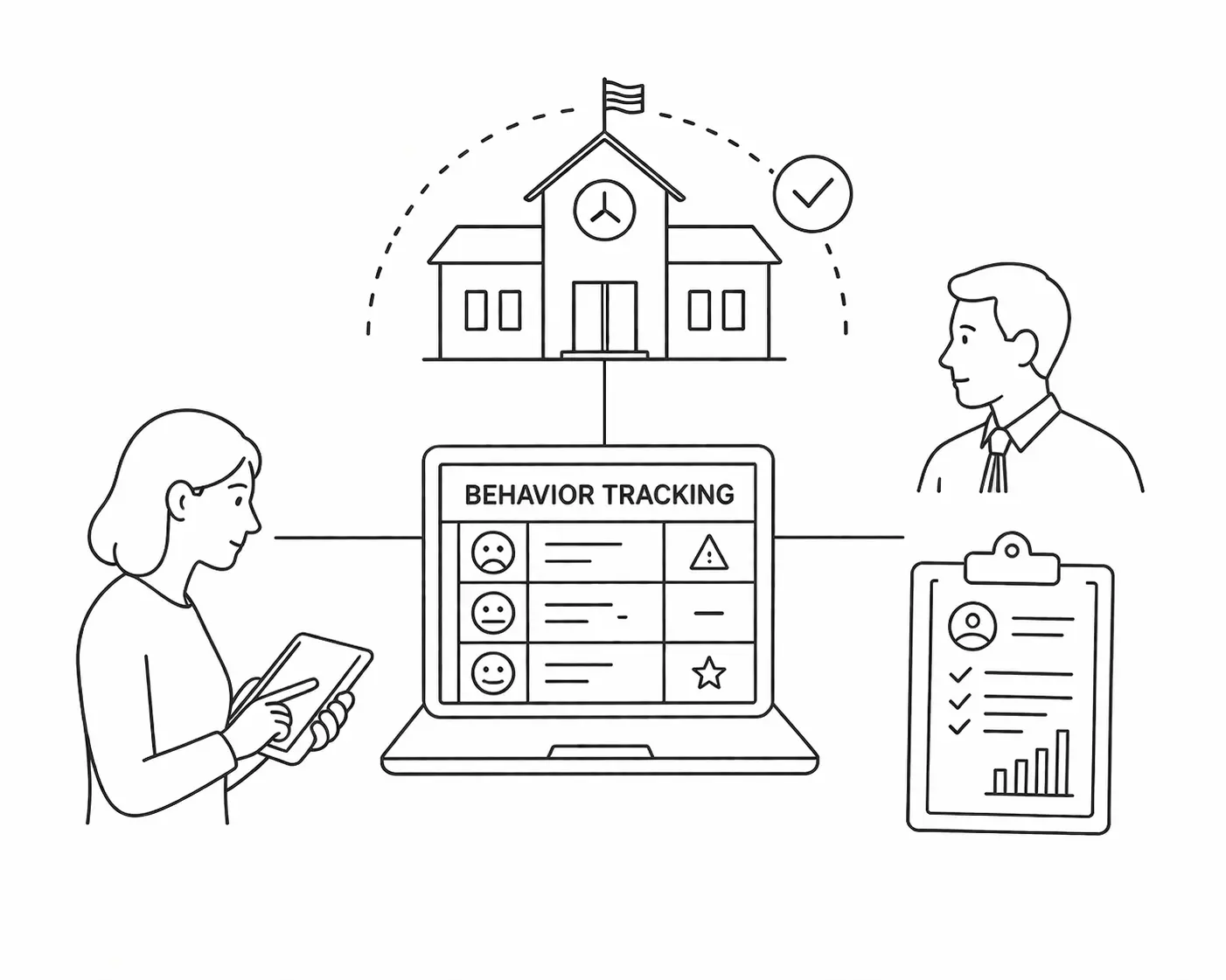
If your school is searching for school behavior tracking software, the real question is usually not just “Which tool should we buy?” It is: How do we create a behavior tracking system that staff will actually use consistently, and that gives us data we can act on?
That is where many schools struggle.
They may already have behavior forms, office referrals, PBIS expectations, spreadsheets, teacher notes, and discipline records. But when the system is fragmented, behavior data becomes hard to trust. Some teachers log everything. Others log almost nothing. One grade level uses one language, another uses completely different terms, and by the time a leadership team tries to review patterns, the information is incomplete or too messy to guide decisions.
A system that actually works school-wide needs to be simple, consistent, and useful.
Quick answer: what effective school behavior tracking software should do
The best school behavior tracking software helps schools:
- log behavior incidents consistently across staff,
- track both negative and positive behaviors,
- organize school behavior data by student, class, teacher, and date,
- identify patterns early,
- support PBIS or MTSS workflows,
- and make documentation easier for teachers and administrators.
In other words, a good system does not just collect behavior records. It turns them into something schools can actually use.
Why most school behavior tracking systems break down
A lot of schools do not fail because they lack concern about student behavior. They fail because their systems are too hard to use or too inconsistent to trust.
Inconsistent definitions
One teacher marks a student as “disruptive.” Another writes “off task.” A third logs “classroom disrespect.” These may describe similar behavior, but they do not create clean data.
Without shared categories and expectations, school discipline tracking quickly turns into subjective notes instead of usable school-wide information.
Too many disconnected tools
It is common for schools to track behavior across:
- paper referral slips,
- email threads,
- spreadsheets,
- SIS notes,
- classroom apps,
- and separate intervention documents.
That creates duplication and confusion. Staff spend time entering the same information twice, or worse, they stop logging it altogether.
Data gets recorded but not used
Some schools are actually good at collecting behavior data. The problem is that nobody reviews it in a meaningful way.
If behavior records do not help answer questions like these, the system is not working:
- Which students need support now?
- Which classes or time blocks show patterns?
- Are certain behaviors increasing?
- Are interventions helping?
- Are positive behavior supports being documented too?
What is school-wide behavior tracking?
School-wide behavior tracking is the process of recording, organizing, and reviewing student behavior data across the entire school using shared definitions and a consistent workflow.
That sounds simple, but it is very different from casual classroom note-taking.
Classroom notes vs school-wide behavior data
A teacher keeping private notes may be helpful for that individual teacher, but it is not the same as a student behavior management system.
School-wide behavior tracking should allow a school to see:
- recurring issues across settings,
- repeated patterns over time,
- behavior trends by student,
- classroom-level or grade-level hotspots,
- and the connection between behavior, attendance, and other support needs.
Why consistency matters across teachers and grade levels
A school cannot make good decisions from uneven data.
Consistency matters because behavior systems are often used for:
- parent communication,
- intervention planning,
- PBIS review,
- MTSS support decisions,
- documentation for recurring concerns,
- and school climate analysis.
When every teacher logs behavior differently, the school ends up with information, but not insight.
Why schools need a student behavior management system
A proper student behavior management system is not only about discipline. It is about support, visibility, and follow-through.
Better intervention decisions
Schools often realize too late that a student has been struggling for weeks because no one saw the full pattern.
A centralized system makes it easier to spot trends such as:
- repeated minor disruptions,
- increased emotional outbursts,
- frequent peer conflict,
- refusal behaviors,
- or a sudden shift from typical behavior.
Those patterns matter because intervention works better when schools act early.
Stronger documentation
Documentation matters for meetings, family communication, staff coordination, and follow-up. If behavior records are scattered across emails and notebooks, schools lose context.
Good school behavior data should be:
- timestamped,
- searchable,
- consistent,
- and easy to retrieve later.
Cleaner school discipline tracking
Not every behavior issue should become a major referral. But schools do need a clear record of what happened, when it happened, and how it was handled.
A good system supports discipline tracking without forcing every incident into the same high-severity bucket.
Easier PBIS implementation
Many schools searching for PBIS software are really trying to solve a broader workflow problem. They want to reinforce expectations, monitor trends, and respond consistently.
Behavior tracking software helps support PBIS when it allows schools to log both:
- problem behaviors,
- and positive behavior evidence.
That balance is important. A school should not build a system that only documents what went wrong.
The core parts of a behavior tracking app for schools
A useful behavior tracking app for schools needs more than a note field and a date stamp. It should support the way schools actually work.
1. Standardized behavior categories
The system should let schools define shared behavior categories such as:
- disruption,
- defiance,
- aggression,
- inappropriate language,
- noncompliance,
- bullying,
- property misuse,
- off-task behavior,
- and positive behaviors such as leadership or cooperation.
The point is not to create endless categories. It is to make sure staff are using the same language.
2. Tiered incident tracking
Schools need to distinguish between low-level patterns and major incidents.
For example:
- Tier 1: minor classroom disruption, off-task behavior, redirection needed
- Tier 2: repeated behavior, conflict, refusal, recurring disrespect
- Tier 3: safety concerns, major aggression, severe incidents, office-level intervention
This helps staff avoid overreacting to small issues while still preserving a clear history.
3. Positive behavior logging
A school-wide system should not only capture discipline events. It should also make it easy to log positive behavior.
That matters for:
- PBIS recognition,
- more balanced student records,
- family communication,
- and teacher morale.
A student with a rough week should not have a file that only reflects the hardest moments.
4. Student history and pattern visibility
One isolated note tells you very little. Pattern visibility is what turns notes into actionable data.
A school should be able to answer questions like:
- Has this behavior increased in the last 30 days?
- Is it happening mostly in one class?
- Is attendance part of the pattern?
- Have previous supports already been tried?
5. Staff-friendly data entry
If logging behavior takes too long, staff will avoid it.
The best behavior tracking software for K-12 schools is easy enough that a teacher can log an event quickly between tasks. That usually means:
- simple categories,
- fast selection options,
- minimal extra typing,
- and a clean record format.
6. Reporting by student, class, and school
A system should allow school leaders and support teams to review behavior data at different levels.
That includes reports by:
- student,
- homeroom or class,
- teacher,
- grade level,
- behavior type,
- and date range.
Without reporting, the platform becomes a storage bin instead of a decision-making tool.
How to track student behavior school-wide
If a school is wondering how to track student behavior school-wide, the answer is not “start collecting more data.” The answer is to build a manageable system.
Step 1: define what gets tracked
Start with a clear scope.
Decide whether staff should log:
- only office referrals,
- classroom behavior incidents,
- repeated minor behaviors,
- positive behavior examples,
- intervention follow-ups,
- or all of the above.
Trying to track everything from day one usually creates overload. Start with the most useful categories.
Step 2: create shared behavior categories
A school-wide system works best when staff are trained on common definitions.
For example, define the difference between:
- disruption,
- defiance,
- disrespect,
- aggression,
- and noncompliance.
This reduces subjective logging and improves data quality.
Step 3: decide who logs what
One major source of failure is role confusion.
Clarify:
- what classroom teachers log,
- what specialists log,
- what office staff enter,
- and what administrators review.
A system with no ownership becomes inconsistent quickly.
Step 4: review patterns weekly
Behavior data should not just sit there.
A weekly review process helps schools notice:
- students with repeated incidents,
- classes with rising behavior concerns,
- trends by behavior type,
- and whether certain supports are reducing issues.
Even a 15-minute weekly check can improve how the system functions.
Step 5: use data for intervention, not just consequences
A strong school behavior system is not just punitive. It should help schools ask better questions:
- What is triggering the behavior?
- Is this pattern linked to attendance?
- Has the student had recent changes or stressors?
- Do we need reteaching, support, family communication, or a formal intervention?
This is where school behavior data becomes valuable.
What to look for in the best behavior tracking software for K-12 schools
If you are evaluating the best behavior tracking software for K-12 schools, do not focus only on feature count. Focus on whether the tool supports actual adoption.
Ease of use
If teachers find it annoying, your system will fail no matter how advanced the reporting is.
Look for software that is:
- easy to learn,
- quick to use,
- visually clear,
- and simple enough for daily use.
School-wide visibility
A school-wide tool should help the right people see the right information. That may include teachers, support staff, intervention teams, or administrators depending on the workflow.
The important thing is that records are not trapped in personal notebooks or isolated spreadsheets.
Searchable records
Behavior history should be easy to find later. This matters for parent meetings, intervention planning, and pattern review.
Reporting and trend spotting
Good reporting helps schools move from anecdotal impressions to evidence-based support.
Integration with daily workflows
A behavior platform works better when it does not live in isolation. Schools often need behavior records alongside attendance, student notes, classroom documentation, or progress information.
That is one reason some schools prefer broader school workflow tools over narrow single-purpose apps.
PBIS software vs broader school behavior tracking software
This is an important distinction.
When PBIS-focused tools help
A dedicated PBIS software platform can be useful when a school mainly wants to:
- reinforce school-wide expectations,
- track rewards or points,
- recognize positive behavior,
- and support a PBIS framework very explicitly.
That works well in some environments.
When schools need a broader behavior data system
Many schools need more than PBIS rewards or referral tracking. They need one organized place for:
- behavior notes,
- student records,
- attendance context,
- teacher documentation,
- and follow-up history.
In those cases, a broader school behavior tracking software solution may be more practical, especially if the school wants to avoid juggling several disconnected tools.
Common mistakes schools make
Even with good intentions, schools often build systems that collapse under real-world use.
Tracking only severe incidents
If staff only log major office-level issues, the school misses the early warning signs. Smaller repeated behaviors often reveal the pattern first.
Making categories too vague
“Behavior issue” is not useful. Specific categories improve accuracy and make reporting more meaningful.
Overcomplicating the process
Some systems ask teachers to fill out too much information every time. That slows adoption.
A good rule is this: capture enough context to be useful, but keep the logging process short.
Failing to close the loop
Behavior records should lead somewhere. If staff log concerns but never review them, the process starts to feel pointless.
A practical example of a school-wide behavior workflow
Here is what a simple but effective workflow can look like:
- Teachers log notable behavior events using shared categories.
- Minor incidents stay visible at the classroom level.
- Repeated patterns trigger review by support staff or administration.
- Positive behaviors are logged alongside concerns.
- The school reviews weekly patterns by student and class.
- Support actions are documented so the record shows what happened next.
This kind of workflow gives schools better visibility without forcing every behavior event into a formal discipline referral.
Where Lekktura fits
For schools trying to move away from scattered spreadsheets and disconnected notes, Lekktura can fit naturally into this workflow.
Instead of keeping behavior records in one place, attendance in another, and classroom notes somewhere else, schools can use Lekktura as a more organized system for day-to-day documentation and student tracking.
That is especially helpful for teams that want:
- simpler school-wide documentation,
- cleaner behavior records,
- easier access to student history,
- and a platform that supports practical educator workflows without unnecessary complexity.
So while some schools search specifically for a behavior tracking app for schools, what they often need is a broader system that helps staff stay organized and consistent. That is where a platform like Lekktura becomes useful as a practical solution, not just another disconnected tool.
Is there a free behavior management system for schools?
Some schools search for a behavior management system for schools free because budget is a real issue. That makes sense.
But free tools usually come with tradeoffs:
- limited reporting,
- inconsistent support,
- fewer school-wide workflow features,
- or a design that works for individual classrooms better than full-school use.
For a school testing a process, a free option may be enough to start. But for long-term school-wide use, the better question is not just “Is it free?” It is “Will staff actually use it, and will the data help us make better decisions?”
A cheap or free tool that creates incomplete data can cost more in staff time and missed intervention opportunities than a system that works properly.
Conclusion
A good school behavior tracking software system should make behavior data clearer, more consistent, and more actionable across the whole school.
The schools that do this well usually keep the process simple. They define shared categories, make logging easy, review patterns regularly, and use behavior data to support students early instead of only reacting later.
That is what separates systems that look good on paper from systems that actually work.
If your school is trying to improve school discipline tracking, strengthen PBIS implementation, or build a more consistent student behavior management system, the goal is not just to record incidents. The goal is to create a reliable school-wide process that gives staff usable information and supports better decisions.
Looking for a simpler way to track behavior school-wide?
If your school wants one place for behavior records, attendance, and everyday classroom documentation, explore Lekktura for Schools: https://lekktura.com/school
It can help reduce spreadsheet chaos and make school-wide tracking more consistent and easier to manage.


