
School-Wide Behavior Tracking Software
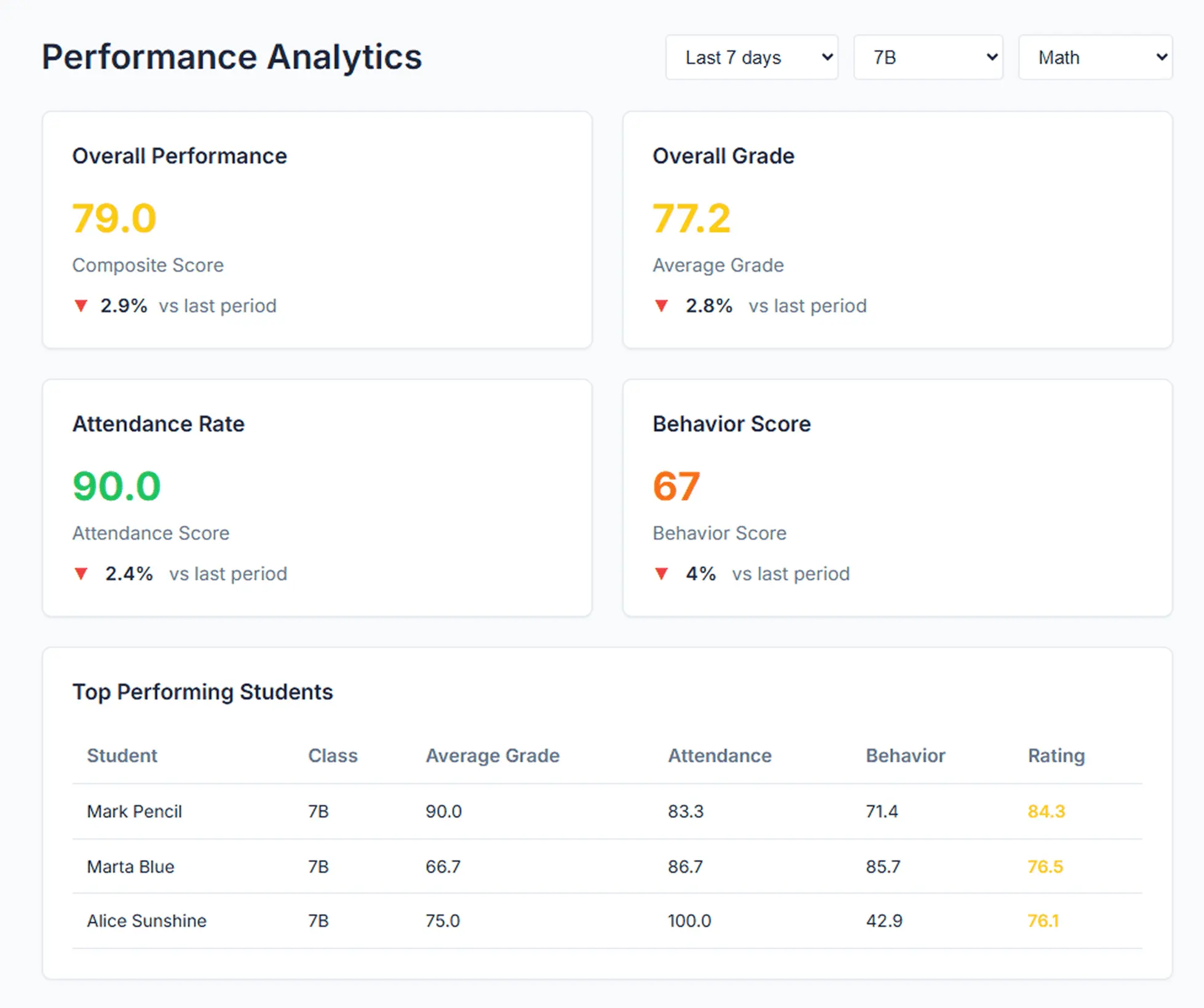
Behavior data is worth having only if it is recorded the same way by everyone. Lekktura keeps behavior notes next to grades and attendance for the same lesson, so a school can see patterns building across classes instead of discovering them at a parent meeting.
- Logged alongside grades
- Consistent across classrooms
- Supports PBIS and RTI
No credit card required · Set up in days, not months
Why per-classroom behavior logs do not add up
A student who is disruptive in one class is a classroom management issue. The same student showing the same pattern in five classes is something else entirely — but nobody sees it if each teacher keeps notes privately.
School-wide tracking is not about collecting more incidents. It is about making the second case visible early enough to intervene, and about making sure two teachers describing the same behavior are describing it the same way.
Recorded in the same pass as everything else
Behavior is captured on the same screen as grades and attendance for that lesson. This matters more than it sounds: a separate behavior system is a separate login and a separate habit, and separate habits are the ones that get dropped first when a week gets busy.
Entries tied to a student, a subject, and a date
Both positive and negative entries, so the record is not only a discipline log
Bulk entry when a whole class earns the same note
Visible to the staff who teach that student and to school leadership
Positive entries are not decoration
A log that only records problems produces a distorted picture of a child and, in practice, gets used less. Teachers are more willing to keep a record that reflects what is going well, and families are far more willing to engage with one.
It also changes what the data is good for. A student whose positive entries stop appearing is a signal that arrives earlier than the first incident.
Supporting PBIS and RTI
Tiered support models depend on data that shows whether an intervention is working. Because entries accumulate per student over time and stay attached to the subject and date, staff can compare the period before an intervention with the period after it, rather than relying on recollection at a review meeting.
The same record supports the documentation side of these frameworks: what was noticed, when, by whom, and what happened next.
Keeping it fair
Behavior records are visible to the staff who work with that student and to leadership — not to the whole school. Parents see their own child only. The aggregated school view exists to show where support is needed, not to rank teachers or classes against each other.
That is a deliberate choice. A behavior log that staff believe will be used to judge them produces careful, sparse, unhelpful data.
Which schools this fits
Student behavior tracking only works when the whole staff uses the same system. That makes school size and staff buy-in more important than the feature list of any behavior management software.
Schools running PBIS or a tiered intervention model get the most from it, because the record is what those frameworks depend on.
Schools running PBIS, RTI or another tiered support model
Private schools and charter schools standardising discipline tracking
Elementary schools wanting positive as well as negative records
Middle and high schools where one student is seen by many teachers
Small districts replacing per-classroom behavior charts
Schools that need documented evidence for intervention reviews
What to check when comparing behavior tools
Behavior tracking is where school software most often gets bought and then abandoned. Worth checking before you commit:
-
1
Whether logging happens in the same place as grades and attendance
-
2
Whether positive entries are supported, not just incidents
-
3
How long one entry takes during a live lesson
-
4
Whether leadership sees patterns across subjects, not just per classroom
-
5
Who can read a student’s behavior history, and who cannot
-
6
Whether the data can support a review meeting months later
Questions before you start
Short answers to what schools ask most.
What is school-wide behavior tracking?
School-wide behavior tracking means every teacher logs student behavior in one shared system using the same categories, instead of keeping private notes. It lets a school see whether a pattern is limited to one classroom or is appearing across a student’s whole timetable.
Does it support PBIS?
Yes. Both positive and negative entries are recorded, so the log reflects the full picture rather than only incidents. Because entries are attached to a subject and date over time, staff can compare the periods before and after an intervention to see whether it is working.
Can it be used for RTI documentation?
Yes. The record shows what was observed, in which subject, on which date, and accumulates across the year. That gives a review meeting something more reliable than recollection when deciding whether a student should move between tiers of support.
Who can see a student’s behavior record?
Teachers assigned to that student’s classes, plus principals and school administrators. Parents see only their own child, through a private report link. Access follows the same role rules used for grades and attendance across the platform.
Is behavior data used to evaluate teachers?
No. The aggregated view is built to show where students need support, not to compare staff. This is deliberate: when teachers believe a log will be used to judge them, they record less and less honestly, and the data stops being useful to anyone.
Do parents see behavior notes?
Parents see behavior for their own child as part of the progress report covering the recent period, alongside grades and attendance. They do not see other students, and they do not need an account to open it.
Is this a discipline tracking system?
It records behavior, both positive and negative, rather than administering sanctions. Schools use it as the evidence layer underneath their own discipline policy: what happened, in which subject, when, and what changed after an intervention.
Can teachers use it for classroom behavior management too?
Yes. A teacher logs behavior for their own lessons as part of the same pass as grades and attendance. The school-wide view is what turns those individual classroom records into a pattern leadership can see.
More for schools
Other parts of the platform your school will use every day.
Run Your School's Daily Academic Workflow in One Place
Create your school, invite teachers by email, and start recording real grades and attendance during the pilot. No installation, no IT project.
30-day free pilot · No credit card required